Showing posts with label Beverly. Show all posts

Friday, April 4, 2014

The "Magic Semicircle": The Future of the Route 128 Corridor

“Route 128 is more than a highway…It is, as the blue signs posted for many years, ‘America’s Technology Region.’”


This week, the Martin Institute for Prosperity published a new report, “Start-up City: The Urban Shift in Venture Capital and High Technology.” Written by University of Toronto/NYU Professor Richard Florida (author of The Rise of the Creative Class), the report finds that while “[s]uburban high tech is not going away…the newest and most innovative developments in the industry are likely to emerge from urban and urban-like locations.”

While the 128 corridor remains, in Florida’s words, a “classic suburban nerdistan,” the highway once known as “the road to nowhere” has lost share of VC funding in recent years to Cambridge and Boston.  Indeed, while the “978” remains the 15th largest recipient of VC funding—with 42 deals worth nearly $350 million in 2012—there is room to grow VC funding on the 128 belt—particularly in Essex County, as shown in the map below.
Source: "Start-up City" Report, Martin Institute, p.25

How then can Massachusetts poiicymakers ensure that the “Massachusetts Miracle” of the 1970s, which witnessed the establishment of Route 128 as one of the nation’s leading tech hubs does not fade into the Massachusetts mirage? [for a terrific primer on Route 128’s history, check out “Silicon Valley and Route 128: The Camelots of Economic Development,” in the May 2013 issue of the Journal of Applied Research in Economic Development].

We can start to answer that question by defining what cities and towns in Essex County cannot do: become dense metropolises like New York City. The infrastructure of the North Shore won’t allow it and the proud history of the Essex County National Heritage Area precludes communities from tectonic shifts in development priorities.

To state the obvious, Northeast Massachusetts can’t compete with New York and San Francisco on the playing field of the “global city.” Instead, our region must leverage its unique assets to drive growth in a way that shows fidelity to history and takes advantage of new modes of suburban living that emphasize mixed-use, sustainable neighborhoods.

We already have models of what these walkable suburban centers can look like. Salem and Lynn earn relatively high scores from WalkScore, but when you drill deeper into the mapping, it is clear that the downtowns of these ancient cities are extremely walkable. Not coincidentally, these downtowns are located near train stations that can whisk residents to Boston in about a half hour.

In recent years, development throughout NE Mass has focused on walkable neighborhoods and live-work environments. As stated in the 2009 Bridge Street Revitalization Plan prepared for Salem, “The Bridge Street Neck neighborhood should be an active mixed-use neighborhood, incorporating lively commercial and residential areas. The neighborhood should have a safe and enjoyable pedestrian environment that connects its different amenities and serves its residents and businesses.” The City of Beverly has also promoted its walkable downtown in its effort to woo business to the home of the Panthers.

Governor Deval Patrick must have been listening. Three years later, he announced a plan called the “Compact Neighborhoods Policy” which calls for the construction of multi-family homes, rental apartments, and starter homes near jobs, transit, and city and town centers. Providing incentives to cities and towns to engage in such “smart growth” is one of the keys to ensuring the continued vitality of the suburban ring, not just the entrepreneurial engines of Boston and Cambridge.

In addition to embracing smart growth and walkable, mixed-use neighborhoods, Essex County also needs to do more to capitalize on the creativity of our college students. Gordon College in Wenham, Endicott College in Beverly, Salem State University in Salem, Northshore CC campuses throughout the region, Merrimack College in North Andover—each of these institutions of higher learning should be nodes for innovation on the North Shore.


Public-private partnerships that position incubators and affordable housing near campuses (linked to downtowns with free/low-cost bus/van transportation) can help to ensure that graduates not only see Essex County as a great place to learn, but also as a prime location to start a business and raise a family. Salem State’s Enterprise Center is a terrific start, but more can be done to harness this enduring asset. In particular, universities should actively partner with existing private sector incubators with proven results, from Newburyport’s CleanTech Center to Beverly’s North Shore InnoVentures.

This last element leads me to my final ingredient for the success of the Route 128 corridor—preserving the natural treasures and community assets that make Essex County such a sought-after place to live. This means protecting our beaches, from Salisbury and Crane to Good Harbor and Preston, as well as taking advantage of our history to drive tourism.

But it also means continuing to invest in our schools, many of which consistently rank among the best in Massachusetts. Salem Academy Charter School ranks 5th in the State and 139th in the nation, serving a diverse student body where 2 in 5 students are economically disadvantaged. And last year, Masconomet Regional High School ranked in the top 15 in statewide testing on math and science.


Route 128 may no longer be known as “America’s Technology Region,” but on the North Shore, it remains a critical job corridor in the modern innovation economy—one that can and should be exploited to transform the ancient industrial cities and shipbuilding ports of Essex County into engines of creative class growth.

Friday, March 28, 2014

Essex County Health: A Data-Driven Look

This week, the Robert Wood Johnson Foundation and the University of Wisconsin Population Health Institute released its annual county-by-county health rankings in all 50 states. Today, we’re going to take a deep dive into—you guessed it—Essex County, Massachusetts, to analyze for trends, identify problems, and find solutions.

Essex County is ranked the 6th healthiest county (of 14) in Massachusetts. The good news is that Massachusetts is one of the healthiest states in the country on a wide variety of metrics, from having the lowest percentage of uninsured residents to one of the highest immunization rates in the U.S. (on the other hand, Massachusetts has one of the worst records on binge drinking and health disparity based on level of educational attainment).

The bad news is that we still have a ways to go to root out preventable health dangers, provide all people have access to quality, affordable, preventive care, and arm Bay Staters with the skills and tools they need to keep their families strong.

The North Shore continues to suffer from high rates of impaired/drunk driving. Nearly 1 in 3 driving deaths involve alcohol, above the Massachusetts average of 28 percent and far higher than the national leaders at 14 percent.
           
Essex County also suffers from:

·      the third highest Chlamydia rate in the Commonwealth
·      a well-below average ratio of primary care physicians per capita
·      a high rate of single-parent households (nearly 1/3)
·      the most severe housing problems (overcrowding, high housing costs, or lack of kitchen or plumbing facilities) outside of Boston and the islands
·      long commutes (39 percent of commuters who drive themselves to work commute for longer than 30 minutes each way)

There are a number of steps policymakers should take to address these concerns. First, while only 3.1 percent of residents in the 6th Congressional District (roughly continuous with Essex County) are uninsured, further outreach is needed to communities that remain underinsured.

In Lynn, over 11 percent of residents 18-64 are uninsured, the sixth highest rate in the state. In Salem, nearly 7 percent of 18-64 year-olds are uninsured. In Beverly, 4.6 percent of children are uninsured, the fourth highest rate in the Commonwealth. Furthermore, according to the Census Bureau, over one-third of all uninsured residents of Essex County are immigrants.

Getting these neighbors quality insurance is critical since Blue Cross has found that a significant percentage of the uninsured face a variety of unmet medical needs, from dentists and preventive care to prescription drugs.

Making the Bay State healthier goes beyond insurance, though. It also involves changing habits and encouraging beneficial behavior. Cities and towns in Northeast Mass. should canvass the country for pioneering public health initiatives. In New York City, calorie counts at restaurants have provided transparency to consumers about nutrition information. While evidence is mixed as to their effects, simply making people aware of the choices they are making is a step in the right direction.

In Chicago, Mayor Rahm Emanuel has banned the sale of tobacco products marketed to children in school zones and has taken concrete steps to keep e-cigarettes out of the hands of kids. 

Closer to home, on the South Shore, the Southcoast Hospitals Group has invested in a health van that serves community organizations at sites throughout Greater Fall River, New Bedford and Wareham and surrounding communities, providing free education and screenings to the community. Hospitals in Essex County should work together with local governments to sponsor a similar program.

The Bay State already provides a wellness tax credit for businesses. But Beacon Hill should do more to nudge people toward better health outcomes.

In particular, our sales tax is a mess. For instance, while running sneakers are exempt, cleated sneakers are not. We should exempt cleats, along with condoms and approved weight loss aids to encourage healthy behavior.

Lastly, our schools should be on the cutting edge of nutrition—going beyond was is required by the Mass. School Nutrition Standards, to help reduce childhood obesity that can lead to diabetes. While come students have complained about the lack of cookies, the benefits of healthy lunch in school far outweigh the costs.

Massachusetts has been a leader in public health for generations, ever since the Supreme Court upheld the Commonwealth’s mandatory vaccination law in the landmark case of Jacobson v. Massachusetts, 197 U.S. 11 (1905). It is our responsibility to remain a model for others to follow and, in the process, ensure a better life for our citizens.

Monday, February 10, 2014

The Past, Present, and Future of Heating New England's Homes

“Natural gas, if extracted safely, it’s the bridge fuel that can power our economy with less of the carbon pollution that causes climate change.”

--President Barack Obama, State of the Union Address (28 Jan. 2014)

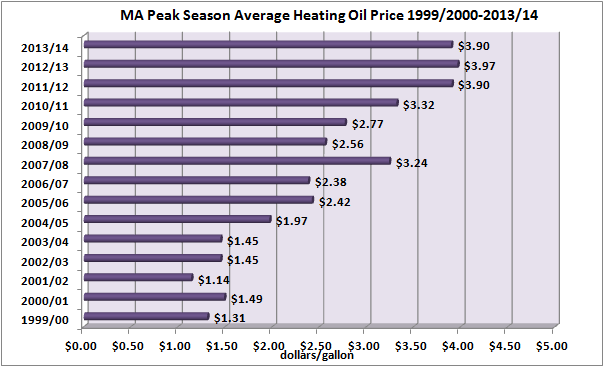
In 2011, the average American household using heating oil spent $2,298, compared with $724 spent by gas users and $957 spent by electricity users. Indeed, the price of heating oil has soared since the end of the Great Recession, continuing a long-term trend that has seen the peak price in Massachusetts rise 200 percent since 2000 (see chart, below).

The significant increase in cost is particularly troubling given ongoing cuts to the Federal Low Income Home Energy Assistance Program.

Nationwide, many households have responded to these soaring costs by taking advantage of both a boom in domestic natural gas production and federal subsidies for natural gas development, driving the percentage of homes that use heating oil from about 20 percent in 1975 to roughly 7 percent in 2012.

New England, however, remains a significant outlier in the home heating market. The latest data from the U.S. Energy Administration shows that more than 7 in 10 Maine households use fuel oil as their primary energy source for home heating—a higher share than in any other state—and in Massachusetts, one in three homes is heated primarily with oil.

One of the reasons for New England’s disproportionate use of oil is the lack of natural gas infrastructure—both production and pipeline capacity. As the Energy Department stated last week, “Since 2012, limited supply from…liquefied natural gas (LNG) terminals coupled with congestion on the Tennessee and Algonquin pipelines has led to winter natural gas price spikes in New England.”

A flashpoint in this drama is the proposed $800 million natural gas retrofitting of the Salem power plant. Last week, the latest protest against the proposed plant took place, led by leaders from the Massachusetts chapter of the environmental group 350.org, which views the construction of new natural gas facilities as a significant threat to global climate.

350’s Chairman and co-founder, Bill McKibben, has described America’s reliance on natural gas as “at best a kind of fad diet, where a dangerously overweight patient loses a few pounds and then their weight stabilizes; instead, we need at this point a crash diet.”

While the environmental benefits of natural gas relative to oil are undeniable (natural gas produces about 30 percent less carbon dioxide per Btu than conventional or ultra low sulfur heating oil, according to a 2009 study by Brookhaven National Laboratory), it is also clear that simply replacing oil and coal with natural gas for home heating and electricity production will not be enough to avoid potentially catastrophic climate change (not to mention the very real concerns of communities surrounding hydraulic fracturing).

Furthermore, as the Energy Department concluded, the capital intensive investments necessary to meaningfully expand New England’s pipeline network may not be financially viable, since additional capacity may only be necessary for short periods during the year.

Nevertheless, just as we must not bestow upon our children a despoiled planet, so we must not ignore the very real suffering of so many families in New England and beyond as a result of soaring heating oil costs.

In addition to dedicating resources at the State level to make up for draconian cuts to home heating assistance (perhaps via a temporary increase the share of Regional Greenhouse Gas Initiative proceeds dedicated to direct assistance), we must promote a truly progressive energy policy—one that draws on Massachusetts’ history of clean energy and the strength of our universities.

Cities and towns throughout the Commonwealth have historically relied on clean energy. For over 150 years, Lawrence has embraced hydroelectric power—from the Great Stone Dam in 1848 to the launch of a hydroelectric plant powering 7000 homes a year, in 1981. In Beverly, Salem, and Marblehead, windmills were grinding corn and bark as early as the 17th and 18th centuries.

In more recent years, the Bay State has continued to propel the clean energy economy. In 1979, the nation’s first modern wind turbine manufacturing company was founded in Burlington and in 2011, UMass and the Maritime Academy worked together on a trial of hydrokinetic energy—using the ancient tides of Buzzards Bay to power iPhones.


With an immense coastline, a regulatory environment supportive of renewables, and countless students committed to investing their futures in the field, Massachusetts is the perfect laboratory for the transformative energy technology of tomorrow.