Showing posts with label Marblehead. Show all posts

Friday, April 4, 2014

The "Magic Semicircle": The Future of the Route 128 Corridor

“Route 128 is more than a highway…It is, as the blue signs posted for many years, ‘America’s Technology Region.’”


This week, the Martin Institute for Prosperity published a new report, “Start-up City: The Urban Shift in Venture Capital and High Technology.” Written by University of Toronto/NYU Professor Richard Florida (author of The Rise of the Creative Class), the report finds that while “[s]uburban high tech is not going away…the newest and most innovative developments in the industry are likely to emerge from urban and urban-like locations.”

While the 128 corridor remains, in Florida’s words, a “classic suburban nerdistan,” the highway once known as “the road to nowhere” has lost share of VC funding in recent years to Cambridge and Boston.  Indeed, while the “978” remains the 15th largest recipient of VC funding—with 42 deals worth nearly $350 million in 2012—there is room to grow VC funding on the 128 belt—particularly in Essex County, as shown in the map below.
Source: "Start-up City" Report, Martin Institute, p.25

How then can Massachusetts poiicymakers ensure that the “Massachusetts Miracle” of the 1970s, which witnessed the establishment of Route 128 as one of the nation’s leading tech hubs does not fade into the Massachusetts mirage? [for a terrific primer on Route 128’s history, check out “Silicon Valley and Route 128: The Camelots of Economic Development,” in the May 2013 issue of the Journal of Applied Research in Economic Development].

We can start to answer that question by defining what cities and towns in Essex County cannot do: become dense metropolises like New York City. The infrastructure of the North Shore won’t allow it and the proud history of the Essex County National Heritage Area precludes communities from tectonic shifts in development priorities.

To state the obvious, Northeast Massachusetts can’t compete with New York and San Francisco on the playing field of the “global city.” Instead, our region must leverage its unique assets to drive growth in a way that shows fidelity to history and takes advantage of new modes of suburban living that emphasize mixed-use, sustainable neighborhoods.

We already have models of what these walkable suburban centers can look like. Salem and Lynn earn relatively high scores from WalkScore, but when you drill deeper into the mapping, it is clear that the downtowns of these ancient cities are extremely walkable. Not coincidentally, these downtowns are located near train stations that can whisk residents to Boston in about a half hour.

In recent years, development throughout NE Mass has focused on walkable neighborhoods and live-work environments. As stated in the 2009 Bridge Street Revitalization Plan prepared for Salem, “The Bridge Street Neck neighborhood should be an active mixed-use neighborhood, incorporating lively commercial and residential areas. The neighborhood should have a safe and enjoyable pedestrian environment that connects its different amenities and serves its residents and businesses.” The City of Beverly has also promoted its walkable downtown in its effort to woo business to the home of the Panthers.

Governor Deval Patrick must have been listening. Three years later, he announced a plan called the “Compact Neighborhoods Policy” which calls for the construction of multi-family homes, rental apartments, and starter homes near jobs, transit, and city and town centers. Providing incentives to cities and towns to engage in such “smart growth” is one of the keys to ensuring the continued vitality of the suburban ring, not just the entrepreneurial engines of Boston and Cambridge.

In addition to embracing smart growth and walkable, mixed-use neighborhoods, Essex County also needs to do more to capitalize on the creativity of our college students. Gordon College in Wenham, Endicott College in Beverly, Salem State University in Salem, Northshore CC campuses throughout the region, Merrimack College in North Andover—each of these institutions of higher learning should be nodes for innovation on the North Shore.


Public-private partnerships that position incubators and affordable housing near campuses (linked to downtowns with free/low-cost bus/van transportation) can help to ensure that graduates not only see Essex County as a great place to learn, but also as a prime location to start a business and raise a family. Salem State’s Enterprise Center is a terrific start, but more can be done to harness this enduring asset. In particular, universities should actively partner with existing private sector incubators with proven results, from Newburyport’s CleanTech Center to Beverly’s North Shore InnoVentures.

This last element leads me to my final ingredient for the success of the Route 128 corridor—preserving the natural treasures and community assets that make Essex County such a sought-after place to live. This means protecting our beaches, from Salisbury and Crane to Good Harbor and Preston, as well as taking advantage of our history to drive tourism.

But it also means continuing to invest in our schools, many of which consistently rank among the best in Massachusetts. Salem Academy Charter School ranks 5th in the State and 139th in the nation, serving a diverse student body where 2 in 5 students are economically disadvantaged. And last year, Masconomet Regional High School ranked in the top 15 in statewide testing on math and science.


Route 128 may no longer be known as “America’s Technology Region,” but on the North Shore, it remains a critical job corridor in the modern innovation economy—one that can and should be exploited to transform the ancient industrial cities and shipbuilding ports of Essex County into engines of creative class growth.

Thursday, March 13, 2014

An Eternal Asset: Making the Most of Essex County’s Waterfront

She knew they were her woods by the smell of pines and the quality of the air, a scrubbed, cool, clean sensation that she associated with the Merrimack River. She could hear the river, distantly, a gentle, soothing rush of sound that was really in no way like static.”

--Joe Hill, NOS4A2 (2013)

As the story goes, in 1004, Thorewald the Norseman, a seafaring fellow meandered down the New England coast in search of the perfect dwelling place. Upon laying his eyes on Cape Ann (or, as others assert, Nahant), Thorewald declared, “It is beautiful; and here I would like to fix my dwelling.”

Whether he was steering his vessel around the jagged cliffs of Rockport, the brilliance of Dolliber Cove, or the tiny peninsula of Nahant, the truth is that Thorewald couldn’t go wrong. Indeed, with nearly 500 miles of coastline, not to mention flowing rivers from the Merrimack to the Ipswich, Essex County is a beautiful a place to fix a dwelling as it was a millennia ago.

It goes without saying that much has transpired since Thorewald’s voyage. In particular, how we engage with our coastline has undergone a series of shifts—from the pre-industrial economy of the colonial era, to the industrial economy of the 19th century and now, as we forge ahead in the 21st, a hybrid of commercial and recreational uses.

Twenty years ago, in a profile of Cape Ann for the New York Times, Suzanne Berne wrote that “[w]hile Gloucester maintains a fishing industry and a palpable grittiness, Rockport has cleated its future to galleries and craft shops.

The tension between a “working waterfront” and the importance of tourism to Essex County’s economy is an important element in how policymakers and communities approach reshaping waterfronts as part of an integrated economic development strategy.

The future of Essex County’s rivers and shores is one of mixed-uses, fighting to protect fisheries and ports, while simultaneously welcoming people to engage with the water in new ways. This model is on display today in Haverhill, where a plan forged through a public-private partnership is in place to reconnect residents with the Merrimack River by literally tearing down a block of buildings that close off the waterfront and rebuilding downtown with office and retail space, apartments, restaurants, a boardwalk, and—most importantly, perhaps—a new satellite campus for UMass-Lowell.

While Haverhill appears ready to pull shovels in the ground this fall, Lynn’s Master Waterfront Plan is now six years old and progress has been frustratingly slow on the 305-acre site which sits a mere 10 miles north of Boston. 2014 may be the year things speed up, though, as ferry service from Lynn to Boston may finally arrive (thanks in no small part to the efforts of State Senator Thomas McGee). Nothing is more important to jumpstart the private-sector investment that is essential to the plan’s success than the creation of transit links like the ferry and the extension of the Blue Line to Central Square.

Despite delays in getting its master plan off the ground, Lynn’s embrace of mixed-use plans along the waterfront, just like that of Haverhill, Gloucester, and communities throughout Essex County, promises to create an “active” street life that promotes business development and reconnects our communities to their historic roots.

Innovative waterfront development must also exploit modern technology and antiquated infrastructure to draw people to the water and teach both tourists and natives alike about the County’s history.

In Gloucester, Mayor Carolyn Kirk has embraced technology as a way to support both critical economic drivers. In 2012, Mayor Kirk launched the Gloucester Harborwalk, 1.2-mile stroll full of stories about Gloucester’s past and present history and fully integrated into a mobile app.

Similarly, the 4.3-mile Danvers Rail Trail (a grassroots project that has transformed an old, unused rail line into an active recreational space) has used technology to link recreational and commercial opportunities, even creating a hide and seek type game with gift cards from local businesses hidden along the trail that require visitors to download a mobile app (as a sidenote, another unused rail spur stretches from Downtown Salem to Peabody and Danvers, allowing for a potential extension of the Danvers Trail to Cedar Pond and the Crane and Waters Rivers).

Other efforts, like the 1.3-mile Amesbury (or Powwow) Riverwalk (part of the Coastal Trails Network linking Amesbury, Salisbury, Newbury, and Newburyport—see map), hold similar promise.


As one of only 49 National Heritage Areas, Essex County’s many historic assets will continue to play a key role in our economic future. However, more eternal and more vital than any colonial home or ancient artifact is our waterfront. It is essential that our cities and towns work together to make the most of its potential for generations to come.

Monday, February 10, 2014

The Past, Present, and Future of Heating New England's Homes

“Natural gas, if extracted safely, it’s the bridge fuel that can power our economy with less of the carbon pollution that causes climate change.”

--President Barack Obama, State of the Union Address (28 Jan. 2014)

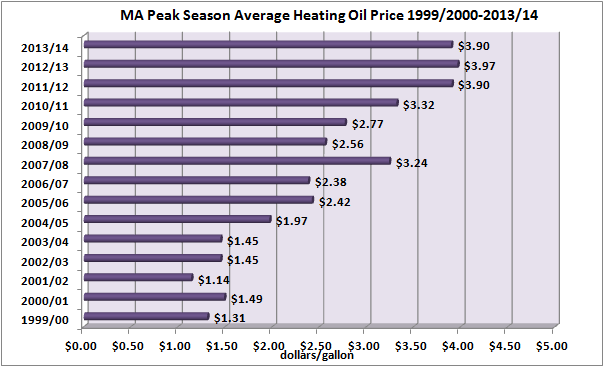
In 2011, the average American household using heating oil spent $2,298, compared with $724 spent by gas users and $957 spent by electricity users. Indeed, the price of heating oil has soared since the end of the Great Recession, continuing a long-term trend that has seen the peak price in Massachusetts rise 200 percent since 2000 (see chart, below).

The significant increase in cost is particularly troubling given ongoing cuts to the Federal Low Income Home Energy Assistance Program.

Nationwide, many households have responded to these soaring costs by taking advantage of both a boom in domestic natural gas production and federal subsidies for natural gas development, driving the percentage of homes that use heating oil from about 20 percent in 1975 to roughly 7 percent in 2012.

New England, however, remains a significant outlier in the home heating market. The latest data from the U.S. Energy Administration shows that more than 7 in 10 Maine households use fuel oil as their primary energy source for home heating—a higher share than in any other state—and in Massachusetts, one in three homes is heated primarily with oil.

One of the reasons for New England’s disproportionate use of oil is the lack of natural gas infrastructure—both production and pipeline capacity. As the Energy Department stated last week, “Since 2012, limited supply from…liquefied natural gas (LNG) terminals coupled with congestion on the Tennessee and Algonquin pipelines has led to winter natural gas price spikes in New England.”

A flashpoint in this drama is the proposed $800 million natural gas retrofitting of the Salem power plant. Last week, the latest protest against the proposed plant took place, led by leaders from the Massachusetts chapter of the environmental group 350.org, which views the construction of new natural gas facilities as a significant threat to global climate.

350’s Chairman and co-founder, Bill McKibben, has described America’s reliance on natural gas as “at best a kind of fad diet, where a dangerously overweight patient loses a few pounds and then their weight stabilizes; instead, we need at this point a crash diet.”

While the environmental benefits of natural gas relative to oil are undeniable (natural gas produces about 30 percent less carbon dioxide per Btu than conventional or ultra low sulfur heating oil, according to a 2009 study by Brookhaven National Laboratory), it is also clear that simply replacing oil and coal with natural gas for home heating and electricity production will not be enough to avoid potentially catastrophic climate change (not to mention the very real concerns of communities surrounding hydraulic fracturing).

Furthermore, as the Energy Department concluded, the capital intensive investments necessary to meaningfully expand New England’s pipeline network may not be financially viable, since additional capacity may only be necessary for short periods during the year.

Nevertheless, just as we must not bestow upon our children a despoiled planet, so we must not ignore the very real suffering of so many families in New England and beyond as a result of soaring heating oil costs.

In addition to dedicating resources at the State level to make up for draconian cuts to home heating assistance (perhaps via a temporary increase the share of Regional Greenhouse Gas Initiative proceeds dedicated to direct assistance), we must promote a truly progressive energy policy—one that draws on Massachusetts’ history of clean energy and the strength of our universities.

Cities and towns throughout the Commonwealth have historically relied on clean energy. For over 150 years, Lawrence has embraced hydroelectric power—from the Great Stone Dam in 1848 to the launch of a hydroelectric plant powering 7000 homes a year, in 1981. In Beverly, Salem, and Marblehead, windmills were grinding corn and bark as early as the 17th and 18th centuries.

In more recent years, the Bay State has continued to propel the clean energy economy. In 1979, the nation’s first modern wind turbine manufacturing company was founded in Burlington and in 2011, UMass and the Maritime Academy worked together on a trial of hydrokinetic energy—using the ancient tides of Buzzards Bay to power iPhones.


With an immense coastline, a regulatory environment supportive of renewables, and countless students committed to investing their futures in the field, Massachusetts is the perfect laboratory for the transformative energy technology of tomorrow.

Friday, February 7, 2014

Sochi 2014 and Boston 2024

http://www.bostonglobe.com/magazine/2014/02/02/boston-should-stop-chasing-its-olympic-dreams/iVMbbRfIwUE6vcQxzGCknL/story.html#

On the night of the Opening Ceremonies of the Winter Olympics in Sochi, I want to take a look at Boston’s bid for the 2024 Summer Olympics and push back against some of the claims made by Shira Springer of the Boston Globe.

Springer lays out the same argument made by many observers of the Olympic Games: namely, that they are very expensive and offer too little in terms of long-term economic development.

However, Springer—like others who denigrate the economic effect of the Games—fails to understand that the lasting legacy of well-run Olympics (like London 2012) is not empty stadiums (London’s Olympic Stadium will soon be filled with a team from the Barclay’s Premier League, its aquatics center is now a world-class community facility, and several of its other arenas have been packed up and sent to Rio de Janeiro for use in 2016). Rather, the lasting legacy is the infrastructure—specifically, transportation and housing—that is built for the participants in and spectators of the Games.

Springer notes that London spent $15 billion on the Games. But what if I told you that nearly $12 billion of that sum was spent on transformative, permanent improvements to London’s transit network, including:

·      Four new or renovated subway lines
·      Dedicated express rail connections between Heathrow Airport and Central London
·      High-speed rail links between East London and Continental Europe
·      Dozens of new bike/pedestrian routes (which paved the way for London’s version of the HubWay to take off in 2010)

These investments—which will support London’s economy for generations to come—would not have been made had London not hosted the Games.

In Boston, we look at our rickety old subway system and wonder if we will ever be able to build out a true 21st century transit network in the Hub. The fact is that plans for subway expansion in Metro-Boston—from the Blue Line to Central Square-Lynn (first discussed in a 1926 report) to the quixotic effort to build a Silver Line subway (first discussed in 1948)– have gone nowhere for 25 years—since the last Red Line stations opened from Harvard Square to Alewife and the Orange Line extended to Forest Hills.

The Olympics would be a catalyst for those investments, as well as improvements at North and South Stations (including the ever-elusive connection between the two hubs), spurred on by the need to move visitors between venues (such as the TD Garden and the Olympic Stadium—which would be perched on the waterfront).

Boston’s Olympic legacy wouldn’t end with transformative transportation projects. Rather, just as London has used the Olympic village to boost affordable housing, so Boston—desperately in need of additional housing stock—would benefit from thousands of units build for the world’s greatest athletes, but intended for Boston’s families.

Lastly, let us not discount the great civic pride that comes with hosting the world for a fortnight. Londoners of all stripes volunteered with spirit to welcome people from all corners of the Globe to their City.

So it would be in Beantown, where baseball’s cathedral would host soccer; the ancient polo fields in my hometown of Hamilton would be the showcase for equestrian (with the Romney’s attendance an essential component); the Charles River, always packed with rowers in October, would host the world’s best sculls; the ancient stone horseshoe of Harvard Stadium would be lit up by world class field hockey; the windy waters of Marblehead as the perfect setting for sailing; the brilliant sand of Singing Beach in Manchester for beach volleyball; and the 26.2 miles from Hopkinton to Copley Square providing the backdrop to the greatest Olympic Marathon of all time.


So here’s to Sochi 2014…and Boston 2024.