Showing posts with label Climate Change. Show all posts

Tuesday, April 1, 2014

Climate and Community: Solarize, Mosaic, and Economies of Scale

“Economies of scale are a good thing. If we didn’t have them, we’d still be living in tents and eating buffalo.”

-- Jamie Dimon, Chairman and CEO, J.P. Morgan, 2010

This weekend, the Globe highlighted Solarize, a pilot program that encourages development of residential and business solar arrays by taking advantage of economies of scale to drive down cost.

Since Beverly High School installed solar panels in 1981 (see image), the North Shore has been at the cutting edge of renewable energy installation. It comes as no surprise, then, that Round 2 of Solarize includes the North Shore communities of Salem and Swampscott, which together have signed up so many people that they have reached “Tier 4” (of 5) status, meaning additional savings for participants in the program and an even greater snowball effect to encourage neighbors to join the movement. Other cities and towns across the Commonwealth are also taking part in the current round, from Andover to Egremont.

In 2011 and 2012, Solarize Mass led over 900 residents and business owners in 21 communities to install over 5.6 megawatts of solar electricity. The 10 cities and towns that participated in Round 1 of 2013—including my beloved Lee, Mass.—added another 3800 kilowatt hours of solar capacity.

This type of community-oriented green energy strategy has emerged with force in recent years. In particular, Mosaic, an investment platform that uses a crowd-funding model to finance solar farms across the country, has showcased the incredible potential of leveraging the pent-up demand for renewable power by bringing individuals together.

From the installation of 47 kWh of solar through Oakland, California’s Youth Employment Partnership (6.38 percent yield) to powering New Jersey’s Wildwood Convention Center (4.5 percent yield) and creating a solar roof on a school in Connecticut (5.5 percent yield), Mosaic has already provided a mechanism for thousands of Americans to directly invest millions of dollars in solar projects in their backyards and across the country.

The uptick in community-based economies of scale is not only spurring green energy (and in turn, reducing carbon emissions), it is also being used by Google to promote high-speed fiber Internet connectivity in cities across the country. Google Fiber expands to “fiberhoods” if/when communities secure enough signups to make the construction of the infrastructure economically viable.

Of course, this model has its pitfalls, particularly when it comes to ensuring access to new technologies across the income spectrum. As Newsweek noted last month, when Kansas City’s fiberhoods were unveiled in 2012, “the online map of fiber-hoods was largely divided by lines like Troost Avenue,” a street that for generations has separated affluent white families to the west and poor families of color to the east.

This outcome was not for lack of trying on Google’s part. As Newsweek stated, the company offered lower-speed broadband service on a monthly payment plan, partnered with community organizations on outreach, and hired people to canvass poor neighborhoods, sometimes with free ice cream. And yet, the divide remained.

This fact should not dissuade us from using community-based economies of scale to nudge neighborhoods toward taking up innovative technology. Rather, it simply highlights the fact that the State must do even more to subsidize the use of green tech in poor communities, many of whom stand to benefit disproportionately from its effects (such as reduced emissions).

In Massachusetts, this means expanding Solarize from the relatively wealthy communities that it has targeted thus far, to communities across the income spectrum—from Lawrence and Lynn to Springfield and Southbridge. It also means changing regulations to allow individual investors to pool resources through platforms like Mosaic.


While Congress dithers on climate policy (and tries to block the President’s historic regulatory efforts related to power plant emissions), communities across the country are hungry to support grassroots efforts to rid America of dirty energy and do their part to make the U.S. a leader in the green tech economy of the 21st century.

Saturday, February 22, 2014

Cowing of Congressional Courage: Flood Maps in a Warming World

“Oh, Master, make me chaste and celibate - but not yet!”

--Saint Augustine, Confessions, 398 CE

In 1968, Congress passed the National Flood Insurance Act, which was designed to reduce federal disaster relief by creating a mechanism to insure vulnerable property on our nation’s shoreline. However, as the Heritage Foundation recently noted, while the national flood insurance program (NFIP) was paved with good intentions, it has ended up promoting development in flood zones, thus paradoxically worsening the effects of natural disasters and saddling taxpayers with the bill in the process.

These subsidies have largely benefitted wealthy Americans. As detailed in a report from the Institute for Policy Integrity at NYU, the Congressional Budget Office (CBO) found that over 40 percent of subsidized coastal properties grandfathered into the NFIP program are worth over $500,000, and 12 percent are worth more than $1 million. Nearly a quarter of the subsidized properties in the CBO’s coastal sample were vacation homes.

Furthermore, as Mindy Lubber, the President of Ceres, noted, “Instead of encouraging behavior that reduces risks from extreme weather events, [NFIP is] encouraging behavior that increases these risks.”

After decades of advocacy by environmental groups, budget watchdogs, and consumer organizations, Congress appeared to commit to fundamental reform of America’s national flood insurance program when it passed the Biggert-Waters Flood Insurance Reform Act of 2012

Biggert-Waters sought to stabilize NFIP finances and protect taxpayers by requiring NFIP to raise rates (through a multi-year phase in) to reflect true flood risk. That process involved updating antiquated flood maps created by the Federal Emergency Management Agency (FEMA) (according to the Government Accountability Office, as of 2008, half of NFIP’s maps were more than 15 years old, and another 8 percent were 10–15 years old).

In the wake of Hurricanes Katrina and Sandy, FEMA has launched an ambitious effort to modernize the flood maps, taking into account the threats of climate change on coastal areas. While it is essential that FEMA ensure the accuracy of these new mapsRockport, Mass. successfully challenged FEMA’s methodology, which should affect maps throughout Cape Ann—the ultimate goal of accurately gauging risk and refashioning insurance rates accordingly is critical to taxpayers and our environment.

And yet, despite the fact that the vast majority of Congress—including Rep. John Tierney (D-MA) and the entire Massachusetts delegation—signed on to the 2012 reform, Congress is now doing it’s best Saint Augustine impersonation—expressing outrage at the effects of its own reform and vowing to roll it back.

The reaction of Congress reminds me of a Seinfeld bit about the check at the end of a meal:

Never liked the check at the end of the meal system, because money’s a very different thing before and after you eat. Before you eat, money has no value. And you don’t care about money when you’re hungry…Then the check comes at that moment. People are always upset, you know. They’re mystified by the check. “What is this? How could this be?” They start passing it around the table, “Does this look right to you? We’re not hungry now. Why are we buying all this food?

Indeed, while Congress was more than willing to engage in disciplined, principled changes to NFIP in 2012, now that the bill has come due, the response is one of shock and outrage.

This is Congress at its worst—trying to have its cake (a courageous vote for reform!) and eat it too (rolling back that reform at the first sign of its effect). That’s why I found myself in complete agreement with Senator Ted Cruz (R-TX) this week when he called out members of his own party for their similarly guileless effort on the debt ceiling. Cruz, a darling of the Tea Party, said that the his colleagues decision to allow a debt ceiling increase to proceed with 50 votes, only to then turn around and vote against the bill, was a “show vote,” and “trickery to the constituents.”

The lack of courage, the bald-faced bait and switch of legislators heralding reform and then shirking from its effects—this is the type of behavior that leads to pitiful Congressional approval ratings and, more importantly, cynicism about the exercise of American Democracy.


To its credit, the Obama Administration has warned against rolling back NFIP reform. One hopes that Speaker John Boehner (R-OH) takes a similar stand when the bill to gut Biggert-Waters comes before the House this week.

Thursday, February 20, 2014

Goldilocks: Flexibility in Carbon Policy and the Fallacy of the "War on Coal"

“If the language in the regulation is too loose, there could be little environmental impact. And if it is too stringent, it could lead to the shutdown of coal plants before there is enough alternative power to replace them.”

-- Coral Davenport, New York Times (4 Feb. 2014)

In coming months, the Obama Administration is set to reveal its climate rule for existing power plants (rules for new plants were published last year) under Section 111(d) of the Clean Air Act. These plants account for about 40 percent of the country’s emissions.

Drafting this rule has proven particularly difficult, not only because the challenge posed by climate change is so daunting, but also because a poorly drafted federal regulation could have dramatically different effects across the nation.

However, while the regulation must not be too loose or too stringent, there is a Goldilocks scenario rooted in Section 111(d), which provides flexibility for states to develop plans that comport with their economic needs and current energy production. Indeed, by taking a mass emissions approach to carbon emission reduction rather than a more targeted “rate-based” approach, the Federal Government will unlock the “states as laboratories” theory that has proven so successful in other aspects of American life.  

Importantly, flexibility of method need not (and should not) mean weakening of the underlying goal. As the Commonwealth of Kentucky wrote in a letter to Environmental Protection Agency Administrator Gina McCarthy in October, “Since President Obama’s goal is to reduce carbon dioxide emissions, and not simply favor one fossil fuel over another, compliance options that take into account demand and supply-side energy efficiency and renewable and other low-carbon generation sources must be allowed.”

Kentucky is a particularly interesting test case. Today, 92 percent of Kentucky’s power is generated from coal. For decades, this has meant low energy costs in Kentucky, leading its economy to become heavily dependent on manufacturing. As a result, as shown in the table, Kentucky’s “energy density” (the amount of energy it uses per Real GDP) is the highest in the nation.


An inflexible carbon emissions standard could potentially shutter Kentucky’s coal plants overnight, not only devastating the Bluegrass State’s economy and imposing considerable pain on working class families, but also leading to an abrupt turn toward natural gas electrical generation, rather than a slower, but more ambitious development of truly clean, renewable energy.

The much-discussed “War on Coal” (an political allegation created by climate change deniers in an effort to thwart any carbon legislation or regulation) does not, standing alone, accomplish the goals we have set forth as a nation vis-à-vis carbon emissions and climate change policy. Rather, the goal of carbon policy must not be to “pick winners and losers”—a task that the government is woefully incapable of performing—but to set ambitious standards and hold states accountable with carrots and sticks.

That’s why we should be encouraged by recent statements by EPA Administrator McCarthy, who told the National Association of State Energy Officials that the EPA would not be “imposing solutions” but would instead “open[] up opportunities” for states to experiment with different ways to reduce emissions.

In the end, even the Goldilocks scenario is unlikely to satisfy many Congressional Republicans, especially those from coal country who face primary challenges from the right (I’m looking at you, Senator Mitch McConnell). For them, the proverbial porridge will go uneaten.

But the rest of us understand that the decisions we make today and the courage to experiment with different approaches will preserve the planet for Goldilocks and the Three Bears for generations to come.

Monday, February 10, 2014

The Past, Present, and Future of Heating New England's Homes

“Natural gas, if extracted safely, it’s the bridge fuel that can power our economy with less of the carbon pollution that causes climate change.”

--President Barack Obama, State of the Union Address (28 Jan. 2014)

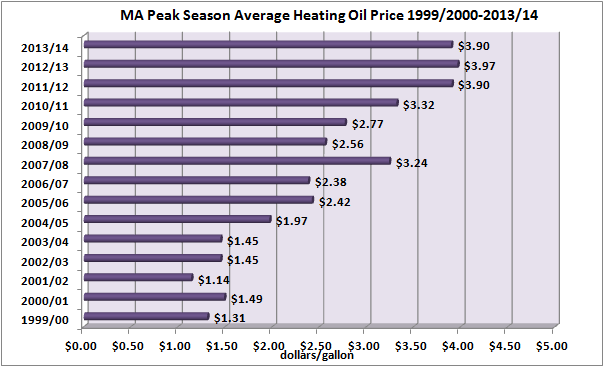
In 2011, the average American household using heating oil spent $2,298, compared with $724 spent by gas users and $957 spent by electricity users. Indeed, the price of heating oil has soared since the end of the Great Recession, continuing a long-term trend that has seen the peak price in Massachusetts rise 200 percent since 2000 (see chart, below).

The significant increase in cost is particularly troubling given ongoing cuts to the Federal Low Income Home Energy Assistance Program.

Nationwide, many households have responded to these soaring costs by taking advantage of both a boom in domestic natural gas production and federal subsidies for natural gas development, driving the percentage of homes that use heating oil from about 20 percent in 1975 to roughly 7 percent in 2012.

New England, however, remains a significant outlier in the home heating market. The latest data from the U.S. Energy Administration shows that more than 7 in 10 Maine households use fuel oil as their primary energy source for home heating—a higher share than in any other state—and in Massachusetts, one in three homes is heated primarily with oil.

One of the reasons for New England’s disproportionate use of oil is the lack of natural gas infrastructure—both production and pipeline capacity. As the Energy Department stated last week, “Since 2012, limited supply from…liquefied natural gas (LNG) terminals coupled with congestion on the Tennessee and Algonquin pipelines has led to winter natural gas price spikes in New England.”

A flashpoint in this drama is the proposed $800 million natural gas retrofitting of the Salem power plant. Last week, the latest protest against the proposed plant took place, led by leaders from the Massachusetts chapter of the environmental group 350.org, which views the construction of new natural gas facilities as a significant threat to global climate.

350’s Chairman and co-founder, Bill McKibben, has described America’s reliance on natural gas as “at best a kind of fad diet, where a dangerously overweight patient loses a few pounds and then their weight stabilizes; instead, we need at this point a crash diet.”

While the environmental benefits of natural gas relative to oil are undeniable (natural gas produces about 30 percent less carbon dioxide per Btu than conventional or ultra low sulfur heating oil, according to a 2009 study by Brookhaven National Laboratory), it is also clear that simply replacing oil and coal with natural gas for home heating and electricity production will not be enough to avoid potentially catastrophic climate change (not to mention the very real concerns of communities surrounding hydraulic fracturing).

Furthermore, as the Energy Department concluded, the capital intensive investments necessary to meaningfully expand New England’s pipeline network may not be financially viable, since additional capacity may only be necessary for short periods during the year.

Nevertheless, just as we must not bestow upon our children a despoiled planet, so we must not ignore the very real suffering of so many families in New England and beyond as a result of soaring heating oil costs.

In addition to dedicating resources at the State level to make up for draconian cuts to home heating assistance (perhaps via a temporary increase the share of Regional Greenhouse Gas Initiative proceeds dedicated to direct assistance), we must promote a truly progressive energy policy—one that draws on Massachusetts’ history of clean energy and the strength of our universities.

Cities and towns throughout the Commonwealth have historically relied on clean energy. For over 150 years, Lawrence has embraced hydroelectric power—from the Great Stone Dam in 1848 to the launch of a hydroelectric plant powering 7000 homes a year, in 1981. In Beverly, Salem, and Marblehead, windmills were grinding corn and bark as early as the 17th and 18th centuries.

In more recent years, the Bay State has continued to propel the clean energy economy. In 1979, the nation’s first modern wind turbine manufacturing company was founded in Burlington and in 2011, UMass and the Maritime Academy worked together on a trial of hydrokinetic energy—using the ancient tides of Buzzards Bay to power iPhones.


With an immense coastline, a regulatory environment supportive of renewables, and countless students committed to investing their futures in the field, Massachusetts is the perfect laboratory for the transformative energy technology of tomorrow.

Tuesday, February 4, 2014

The Next Step in the Climate Fight

http://www.bostonglobe.com/opinion/editorials/2014/01/24/investors-see-green-clean-energy/F7sxg6y3Ljfsp2WwARNGZN/story.html

Derrick Jackson of The Boston Globe recently profiled how investors are gaining greater confidence in renewable energy portfolios. However, the truth of the matter is that while the growth in investments in green energy is encouraging, it is not nearly enough to combat the extraordinary capital spent on extracting oil and gas from all corners of the globe. 

Simply reducing the cost of solar panels or improving the efficiency of wind power is not going to be enough to overcome this devotion to fossil fuels. Rather, the only way to truly turn the tables is to appropriately and effectively charge fossil fuel companies the true cost of their product on the planet.

For far too long, we’ve allowed fossil fuel companies to use our atmosphere as a trash can for their emissions—hurting our environment and our economy. Rather than having government futilely trying to pick winners and losers through tax credits and subsidies, we should employ a carbon tax that uses a free-market mechanism to make polluters pay for the CO2 they omit, while simultaneously reducing taxes like the sales tax that burden low-income Bay Staters.


As part of the Regional Greenhouse Gas Initiative (RGGI), the Commonwealth has already joined with her sister states in a similar effort to reduce power plant emissions and increase investments in renewables. But a broader carbon tax system is urgently needed to ward off climate change and protect our precious shores and rolling hills for generations to come.