Showing posts with label Lawrence. Show all posts

Tuesday, April 1, 2014

Climate and Community: Solarize, Mosaic, and Economies of Scale

“Economies of scale are a good thing. If we didn’t have them, we’d still be living in tents and eating buffalo.”

-- Jamie Dimon, Chairman and CEO, J.P. Morgan, 2010

This weekend, the Globe highlighted Solarize, a pilot program that encourages development of residential and business solar arrays by taking advantage of economies of scale to drive down cost.

Since Beverly High School installed solar panels in 1981 (see image), the North Shore has been at the cutting edge of renewable energy installation. It comes as no surprise, then, that Round 2 of Solarize includes the North Shore communities of Salem and Swampscott, which together have signed up so many people that they have reached “Tier 4” (of 5) status, meaning additional savings for participants in the program and an even greater snowball effect to encourage neighbors to join the movement. Other cities and towns across the Commonwealth are also taking part in the current round, from Andover to Egremont.

In 2011 and 2012, Solarize Mass led over 900 residents and business owners in 21 communities to install over 5.6 megawatts of solar electricity. The 10 cities and towns that participated in Round 1 of 2013—including my beloved Lee, Mass.—added another 3800 kilowatt hours of solar capacity.

This type of community-oriented green energy strategy has emerged with force in recent years. In particular, Mosaic, an investment platform that uses a crowd-funding model to finance solar farms across the country, has showcased the incredible potential of leveraging the pent-up demand for renewable power by bringing individuals together.

From the installation of 47 kWh of solar through Oakland, California’s Youth Employment Partnership (6.38 percent yield) to powering New Jersey’s Wildwood Convention Center (4.5 percent yield) and creating a solar roof on a school in Connecticut (5.5 percent yield), Mosaic has already provided a mechanism for thousands of Americans to directly invest millions of dollars in solar projects in their backyards and across the country.

The uptick in community-based economies of scale is not only spurring green energy (and in turn, reducing carbon emissions), it is also being used by Google to promote high-speed fiber Internet connectivity in cities across the country. Google Fiber expands to “fiberhoods” if/when communities secure enough signups to make the construction of the infrastructure economically viable.

Of course, this model has its pitfalls, particularly when it comes to ensuring access to new technologies across the income spectrum. As Newsweek noted last month, when Kansas City’s fiberhoods were unveiled in 2012, “the online map of fiber-hoods was largely divided by lines like Troost Avenue,” a street that for generations has separated affluent white families to the west and poor families of color to the east.

This outcome was not for lack of trying on Google’s part. As Newsweek stated, the company offered lower-speed broadband service on a monthly payment plan, partnered with community organizations on outreach, and hired people to canvass poor neighborhoods, sometimes with free ice cream. And yet, the divide remained.

This fact should not dissuade us from using community-based economies of scale to nudge neighborhoods toward taking up innovative technology. Rather, it simply highlights the fact that the State must do even more to subsidize the use of green tech in poor communities, many of whom stand to benefit disproportionately from its effects (such as reduced emissions).

In Massachusetts, this means expanding Solarize from the relatively wealthy communities that it has targeted thus far, to communities across the income spectrum—from Lawrence and Lynn to Springfield and Southbridge. It also means changing regulations to allow individual investors to pool resources through platforms like Mosaic.


While Congress dithers on climate policy (and tries to block the President’s historic regulatory efforts related to power plant emissions), communities across the country are hungry to support grassroots efforts to rid America of dirty energy and do their part to make the U.S. a leader in the green tech economy of the 21st century.

Monday, February 10, 2014

The Past, Present, and Future of Heating New England's Homes

“Natural gas, if extracted safely, it’s the bridge fuel that can power our economy with less of the carbon pollution that causes climate change.”

--President Barack Obama, State of the Union Address (28 Jan. 2014)

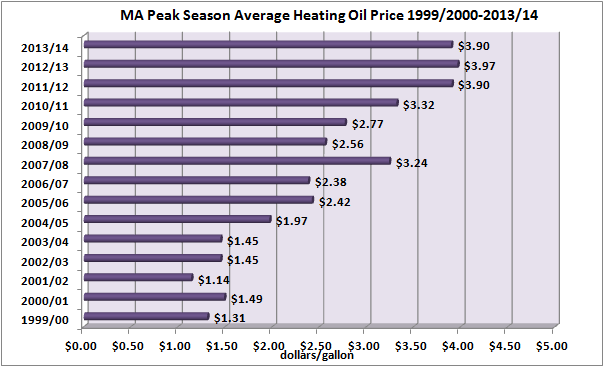
In 2011, the average American household using heating oil spent $2,298, compared with $724 spent by gas users and $957 spent by electricity users. Indeed, the price of heating oil has soared since the end of the Great Recession, continuing a long-term trend that has seen the peak price in Massachusetts rise 200 percent since 2000 (see chart, below).

The significant increase in cost is particularly troubling given ongoing cuts to the Federal Low Income Home Energy Assistance Program.

Nationwide, many households have responded to these soaring costs by taking advantage of both a boom in domestic natural gas production and federal subsidies for natural gas development, driving the percentage of homes that use heating oil from about 20 percent in 1975 to roughly 7 percent in 2012.

New England, however, remains a significant outlier in the home heating market. The latest data from the U.S. Energy Administration shows that more than 7 in 10 Maine households use fuel oil as their primary energy source for home heating—a higher share than in any other state—and in Massachusetts, one in three homes is heated primarily with oil.

One of the reasons for New England’s disproportionate use of oil is the lack of natural gas infrastructure—both production and pipeline capacity. As the Energy Department stated last week, “Since 2012, limited supply from…liquefied natural gas (LNG) terminals coupled with congestion on the Tennessee and Algonquin pipelines has led to winter natural gas price spikes in New England.”

A flashpoint in this drama is the proposed $800 million natural gas retrofitting of the Salem power plant. Last week, the latest protest against the proposed plant took place, led by leaders from the Massachusetts chapter of the environmental group 350.org, which views the construction of new natural gas facilities as a significant threat to global climate.

350’s Chairman and co-founder, Bill McKibben, has described America’s reliance on natural gas as “at best a kind of fad diet, where a dangerously overweight patient loses a few pounds and then their weight stabilizes; instead, we need at this point a crash diet.”

While the environmental benefits of natural gas relative to oil are undeniable (natural gas produces about 30 percent less carbon dioxide per Btu than conventional or ultra low sulfur heating oil, according to a 2009 study by Brookhaven National Laboratory), it is also clear that simply replacing oil and coal with natural gas for home heating and electricity production will not be enough to avoid potentially catastrophic climate change (not to mention the very real concerns of communities surrounding hydraulic fracturing).

Furthermore, as the Energy Department concluded, the capital intensive investments necessary to meaningfully expand New England’s pipeline network may not be financially viable, since additional capacity may only be necessary for short periods during the year.

Nevertheless, just as we must not bestow upon our children a despoiled planet, so we must not ignore the very real suffering of so many families in New England and beyond as a result of soaring heating oil costs.

In addition to dedicating resources at the State level to make up for draconian cuts to home heating assistance (perhaps via a temporary increase the share of Regional Greenhouse Gas Initiative proceeds dedicated to direct assistance), we must promote a truly progressive energy policy—one that draws on Massachusetts’ history of clean energy and the strength of our universities.

Cities and towns throughout the Commonwealth have historically relied on clean energy. For over 150 years, Lawrence has embraced hydroelectric power—from the Great Stone Dam in 1848 to the launch of a hydroelectric plant powering 7000 homes a year, in 1981. In Beverly, Salem, and Marblehead, windmills were grinding corn and bark as early as the 17th and 18th centuries.

In more recent years, the Bay State has continued to propel the clean energy economy. In 1979, the nation’s first modern wind turbine manufacturing company was founded in Burlington and in 2011, UMass and the Maritime Academy worked together on a trial of hydrokinetic energy—using the ancient tides of Buzzards Bay to power iPhones.


With an immense coastline, a regulatory environment supportive of renewables, and countless students committed to investing their futures in the field, Massachusetts is the perfect laboratory for the transformative energy technology of tomorrow.